Sam's Physics Project
Thursday, January 9, 2014
Wednesday, January 1, 2014
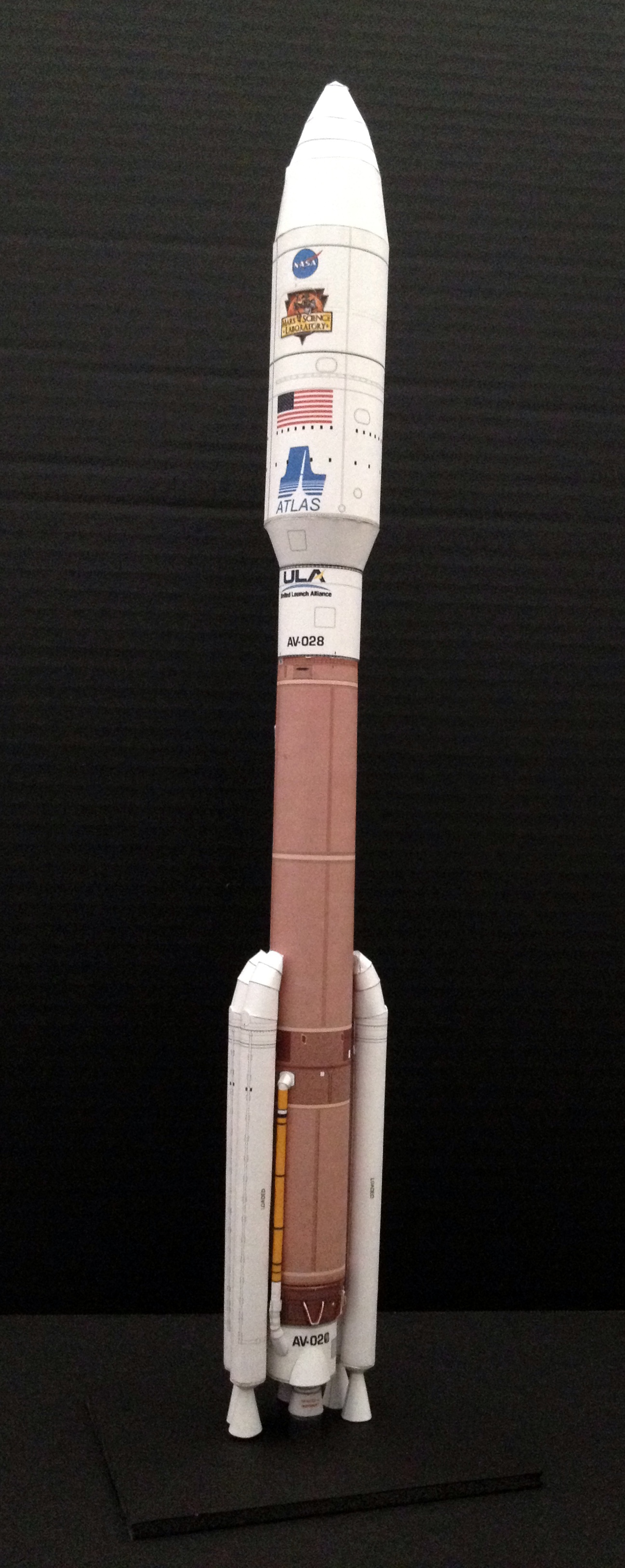
Fuselage Complete!
After much glue, tedious assembly, and patience, the body of the rocket is finally complete! I still have yet to add the 5 solid rocket boosters or SRB's on the lower portion of the craft, I'll save that for later.
Here are some pictures!:
Sunday, December 22, 2013
JUNO Launch Video
Well, after a huge amount of searching for a model that would work without crashing the simulator at launch, I came across a download featuring pretty much every variant of the Atlas V launch system. I ended up recording a launch of an Atlas into orbit. Right now its simply unedited footage so the entire climb to orbit lasts approximately 9 minutes. (The video's pretty boring at the moment.. no sound)
The majority of the nine minutes is of the second stage, as the upper stage's engine has a much higher specific impulse, so it burns fuel much slower than the first stage, which provides the much of the raw force to get the spacecraft above the dense part of the atmosphere. The first stage burns for approximately two minutes and thirty five seconds while the upper stage burns for about six minutes.
In order to achieve orbit, the spacecraft must be traveling around 7.5 kilometers per second! Since the spacecraft is always moving tangentially to the Earth, the craft receive most of this relative horizontal motion by the second stage.
I will also be including a video segment from the main view used during launch, which shows all the real time data needed to properly launch a rocket into space.
Here's a screenshot:
On the left side of the screen is the MFD, or main flight display, it displays velocity, heading, inclination, vertical speed, acceleration, and other things that I'm not really sure what their purpose is. On the right side of the screen with the circle is a display of the current orbit, which shows information of the Apogee and Perigee, the highest and lowest altitudes of the orbit, respectively. The center of the display is a blown up segment of what you see on the MFD with the blue and brown parts. This represents the current pitch of the spacecraft.
Friday, December 13, 2013
'Little' Progress
Really small parts can end up being very time consuming. This week I had time to get some of the small details of the fuselage complete, but overall progress has been sort-of lack luster.
Saturday, December 7, 2013
Atlas V Update #1
I have been working on the model today, I've got the main tube of the rocket assembled, but there's still loads to do!
Friday, December 6, 2013
Preliminary Ideas
The premise of my project is essentially explaining, through terms and concepts we have studied, the dynamics of spaceflight and what is involved in inserting a rocket into orbit. I plan to explain this through two mediums.
The first is a 3-D model, made with card stock paper, which will visually explain how a rocket makes it to space by thrust vectoring and key aerodynamic features.
For the 3-D model I'm going to use schematics from AXM Paper Scale Models. AXM produces very high quality schematics for assembly.
Here's their website: http://axmpaperspacescalemodels.com/
I'm still debating which rocket to build but I'm considering the Atlas V launch system. The Atlas V has launched numerous scientific missions over the years, many being interplanetary mission. One of current importance being the Mars Curiosity Rover or MSL (the 'L' stands for laboratory). The Atlas V also launched the JUNO spacecraft, a interplanetary probe that just recently passed by Earth in October, using the gravity of the Earth to slingshot itself towards its destination, Jupiter. It's goal is to expand our knowledge of gas giants in the Solar System.
AXM has both the JUNO and MSL launch systems:
- JUNO: http://www.axmpaperspacescalemodels.com/images/atlasvjuno.JPG
- MSL: http://www.axmpaperspacescalemodels.com/images/atlasvmsl.JPG
So that sort of touches on the 3-D side of things, now onto the second medium.
For explaining how most of the physics is involved with the spacecraft, I plan to use Orbiter Space Flight Simulator 2010. Orbiter is a highly realistic interpretation of spaceflight of all kinds, not only from NASA, but also from the European Space Agency and Russia's space program to name a couple. Orbiter simulates spaceflight very realistically and will easily show the characteristics of spaceflight.
Link to the Orbiter website: http://orbit.medphys.ucl.ac.uk/
Along with the simulation software, I would have to download a add-on containing the JUNO space craft with the Atlas V 551 used to launch JUNO into space.
I could record a video of the launch, explaining certain elements as the video when on, and show the progression of the spacecraft to being caught by the sphere of influence of the Jovian system.
As of now, I'm sort of leaning towards the JUNO spacecraft, but we'll see, a MSL model might be easier to get working in Orbiter because of its recent popularity.
Anyway, I'm excited to be working on this project, and as you can probably tell by the volume of this post, I love explaining the details of it!
Subscribe to:
Posts (Atom)